
The value of regeneration
Millions of hectares of rangelands have been subject to degeneration through overgrazing, agricultural expansion, urbanisation and afforestation. Countering this, regeneration is a natural process whereby rangeland ecosystems revive themselves. This understanding of regeneration has mostly been missed in definitions of regenerative ranching, which reduce it to a food production approach requiring some combination of practices and/or outcomes.
In this article, we present a fresh framing and demonstrate how regeneration can be held as a broad value amongst ranchers—guiding the way they interact with and attach importance to nature. Broad values are general moral principles and life goals that guide human and non-human interactions. When regeneration is held as a broad value amongst ranchers, it means more than just valuing the natural regenerative processes of social-ecological systems.
There are four dimensions to regeneration as a broad value: (1) a desire to improve degenerated land; (2) a belief in cyclical processes of renewal; (3) a return of agency to non-human parts of the system; (4) a belief that regeneration leads to a good and fulfilling life. Ranchers do not need to undertake practices associated with regenerative ranching to hold regeneration as a broad value, nor do they need to identify as a regenerative rancher.
We suggest that regeneration has the potential to be a widely held broad value in and beyond the context of ranching. As a value, it is potentially consistent with the Kunming-Montreal Global Biodiversity Framework's 2050 Vision for Biodiversity of living in harmony with nature. Promoting regeneration as a guiding value/principle, distinct from practices and outcomes, might help mobilise diverse groups interested in just and sustainable rangeland futures.
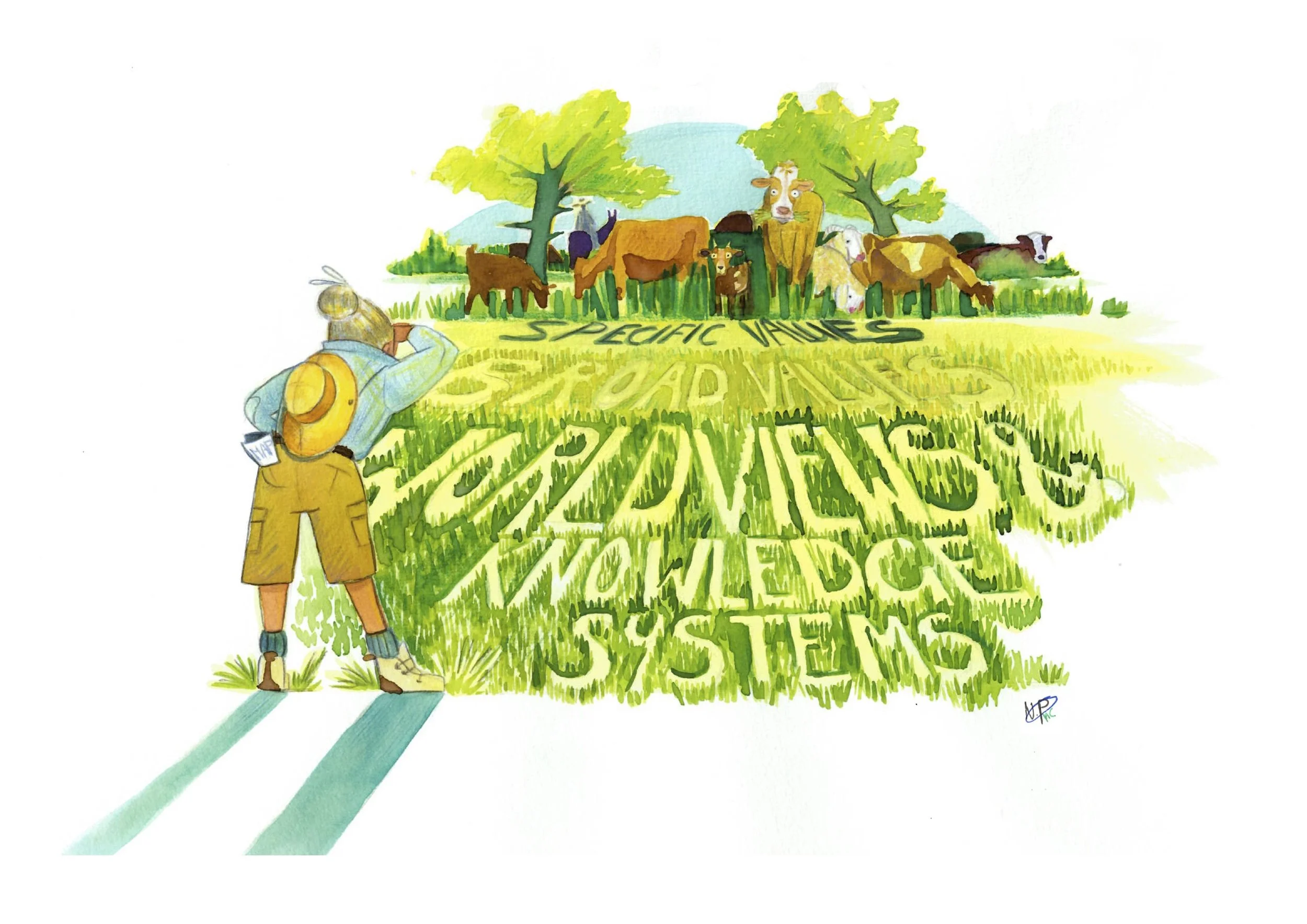
Artwork by Hannah Cox. A rancher sees her herd through her worldviews and values. Promoting regeneration as a guiding value might mobilise more people to protect rangelands than only ensuring specific practices and/or outcomes.